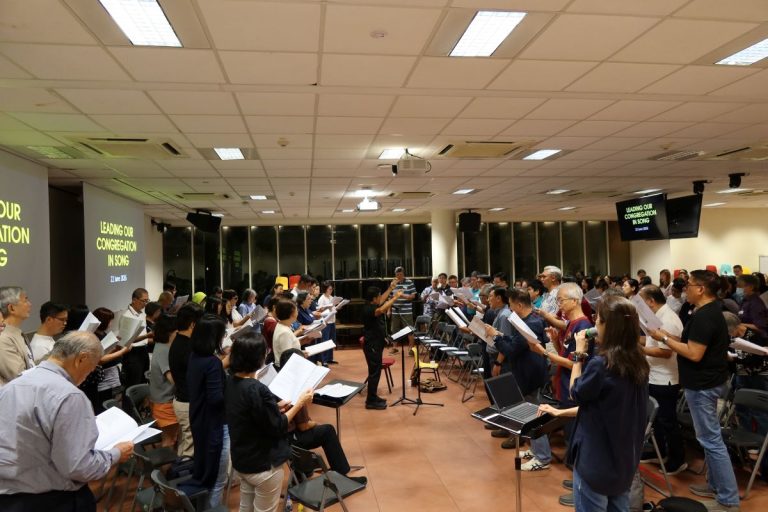
On 22 June 2026, Wesley Worship and Music (W&M) Ministry held its Leading Our Congregation in Song training at the Plaza Hall. Participants included choir members from Wesley Methodist Church’s four Traditional Services, musicians, worship leaders, audio visual team members, ushers, communion stewards and interested congregants. The trainers for the evening were Dr Eudenice Palaruan (Dr Eudy) and Dr Lim Swee Hong. Both are highly regarded Christian music professors.
SIMULATED WORSHIP SERVICE
Have you ever attended a church service where the choir was twice the size of the congregation? The training opened with this unconventional premise – a seating layout of large choir versus a small congregation. Participants from the choral ministry were mostly assigned to the choir, while some choristers joined the rest of the participants as the congregation to gain a different perspective.
This was a role play simulating a choir rehearsal through to the service itself. The first part simulated an average choir in a typical practice. Some choristers snacked or played with their phones. The pianist confused the choir with heavy-handed playing and wrong notes. The ineffectual conductor did not attempt to communicate with the pianist or choir. False starts abounded. The worship leader led the responsive reading in a monotone, causing the uninspired congregation to do the same.
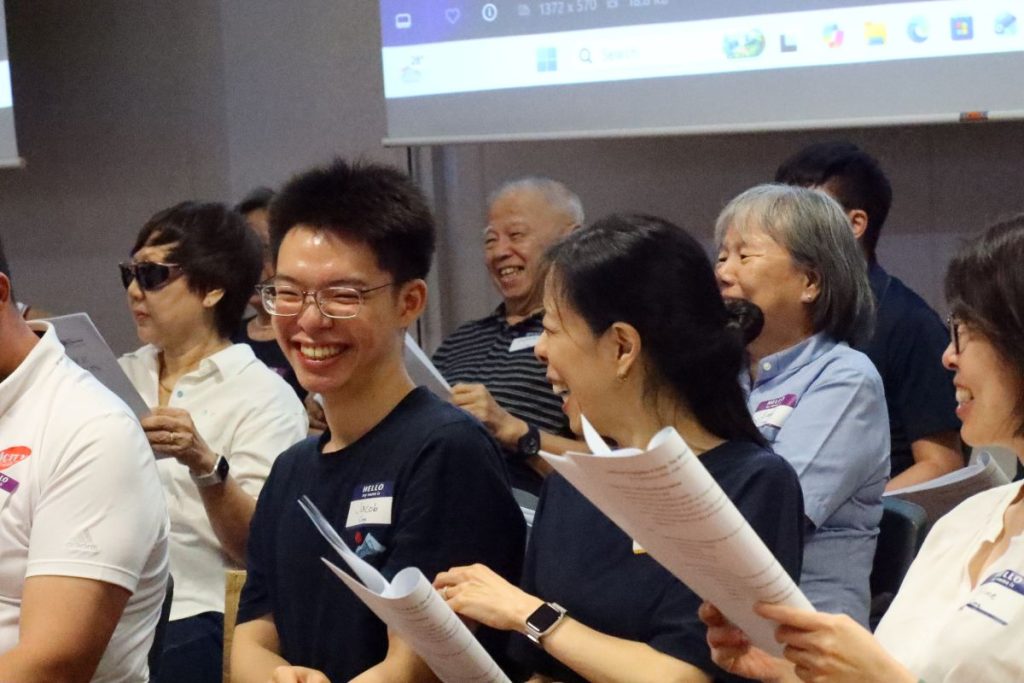
After the “choir” and “congregation” shared their feedback on this under-prepared worship service, the second part of the role play saw noticeable improvements to all aspects of the worship leading. In an inspired moment, the conductor, engaging all of choir, pianist and congregation, spontaneously repeated the lively chorus of the last song, ending our “service” on a rousing high.
LEARNING POINTS FROM THE ROLE PLAY
Through this immersive experience, we learned how much the worship team’s preparation (or lack of it) affects the church’s worship experience. Our conductor for the evening, Dr Eudy, showed by example how a good conductor comes well-prepared, engages the choir by taking up effective leadership, recognises the importance of congregational songs and explains how the lyrics of a song relate to the melody. The choristers can play their part by familiarising themselves with the songs and their spoken parts in the liturgy before each practice. Musician Cheng Xinhui pointed out that, in addition to technical preparedness, it was important for the worship servants to be spiritually present.
Pastoral Team Member Wong Ee Hwee shared that even congregants can prepare for worship by arriving at the Sanctuary early, reading through the liturgy, listening to the choir during their technical run to learn the new songs, and meditating on the Scripture verses shown on-screen before service starts.
Congregant Cecil Chee observed of the role play, “The ‘rigidity’ of the service enabled me to worship freely.” Disciplined preparation by the worship team may appear to be rigid but frees us for joyful expression during the service.
PANEL DISCUSSION
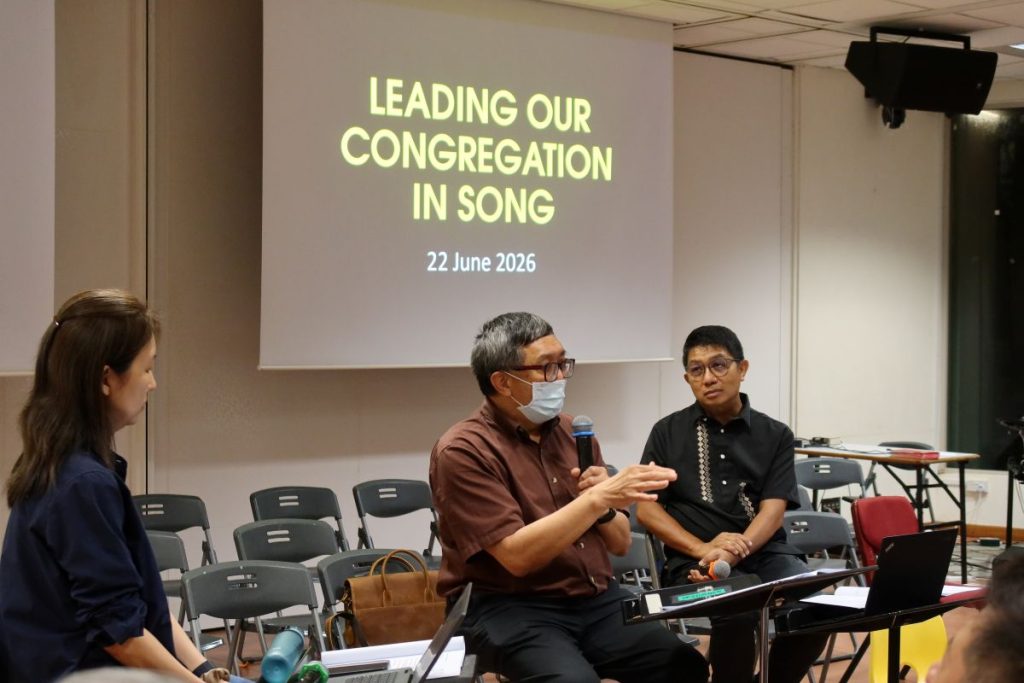
The latter half of the evening featured a panel discussion on the importance of congregational songs and the primary functions of a church choir.
IMPORTANCE OF CONGREGATIONAL SONGS
Congregational songs are written for the congregation to sing in the worship service. They are set to memorable tunes in appropriate keys and vocal range for the average worshipper.
Dr Lim mentioned four functions of congregational songs. Doxological function refers to the praise and adoration of our Lord God. Didactical refers to a teaching function. Diaconal function challenges Christians to serve. Finally, congregational songs are used to accentuate worship action, such as when we sing communion hymns while the elements are being distributed.
The didactical function of congregational songs may not be readily apparent but is nonetheless important and biblically supported. Colossians 3:16 (ESV) states:
“Let the word of Christ dwell in you richly,
teaching and admonishing one another in all wisdom,
singing psalms and hymns and spiritual songs,
with thankfulness in your hearts to God.“
For an illustration of how a congregational song teaches, Good Soil, one of the songs learnt during our training and featured in July’s liturgy, is a reference to the Parable of the Sower. The lyrics reminds us to keep our hearts humble and receptive to God’s word, just like good soil enables seeds to grow.
We were reminded that the “traditional” in “traditional service” does not refer to the type of songs sung during the service, but to the liturgy and the rationale behind it. A Methodist service would always have a clear order of service with preaching and holy communion at its core. New songs which convey the truth of God in present-day context are constantly being written. These, as well as the well-loved classics, can all find their place in a traditional service.
PRIMARY FUNCTIONS OF A CHOIR
Given the importance of congregational songs, the choir must lead those songs well to enable the church to worship effectively. They are not performers, but a catalyst to encourage the congregation to lift their voices to the Lord.
The choir should pay special attention to the enunciation of words of a congregational song so that listeners can understand and internalise its meaning.
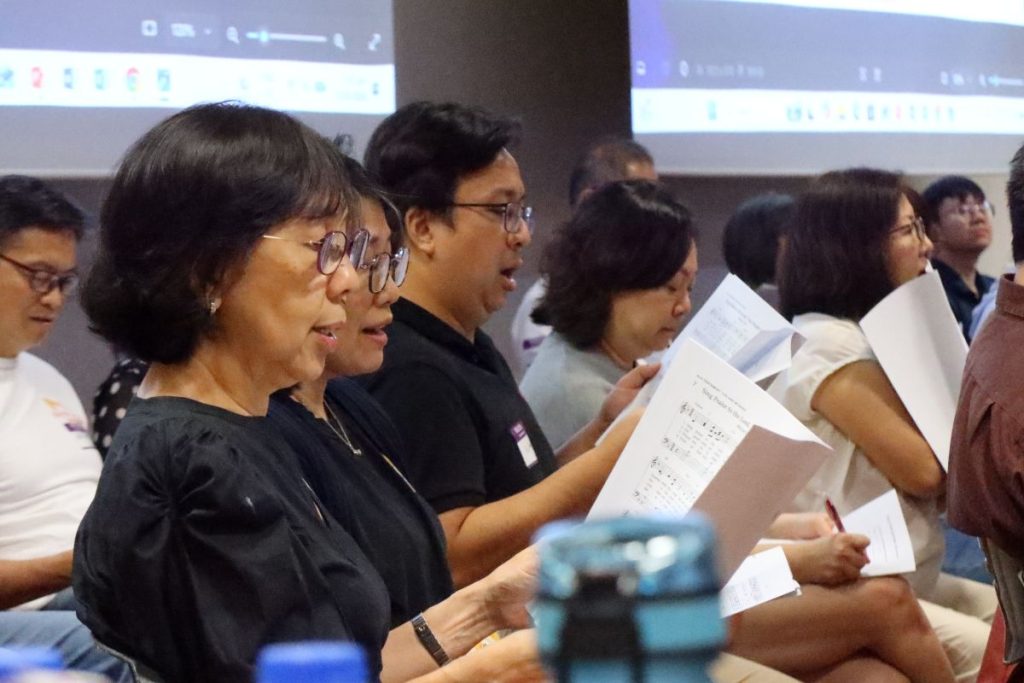
Another suggestion was to sing with gratitude at all times, even when we sometimes do not feel like it. Music is a mysterious thing; it has power to lift spirits and to inspire action. When the choir sings enthusiastically, its act of worship can transform the emotions and attitudes of the congregation. The converse is also true. When choristers see the congregation singing along, the choristers feel energised and inspired to sing better.
PARTICIPANTS’ REFLECTIONS
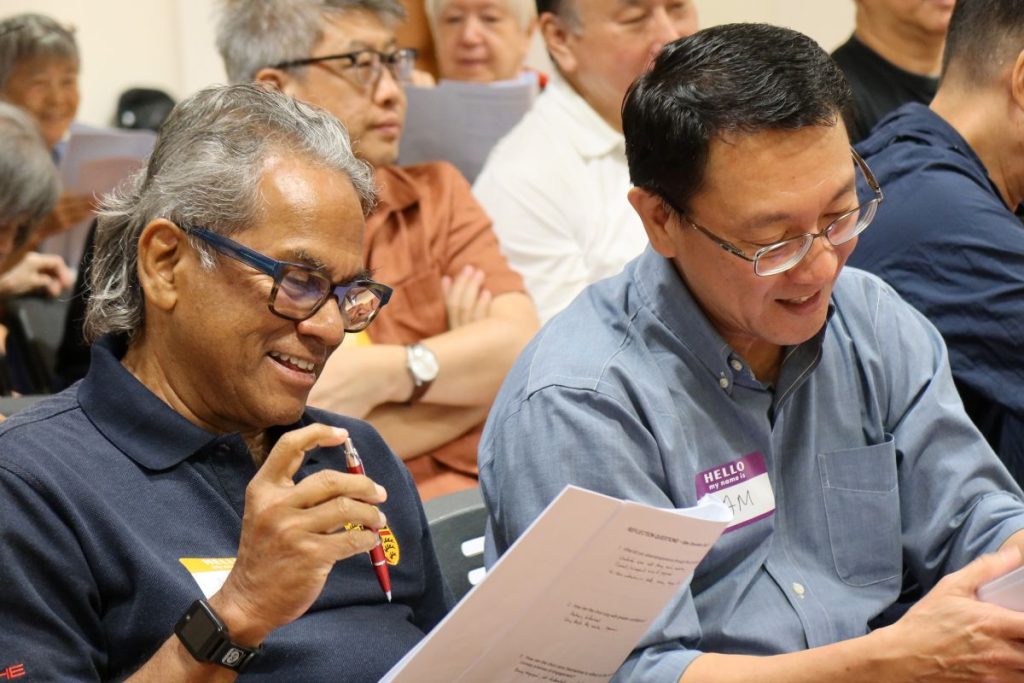
“[I will strive to] review the liturgy prayerfully ahead of time [and] internalise the hymn lyrics, rather than just learning the melody.” – Annie Yii, chorister.
“[I saw] for myself the distracting habits of a choir from the congregant’s view.” – Judy Tan, chorister, who was assigned to be a congregant for the event.
“Study the liturgy more intentionally and be more conscious of the flow of worship action and function of the congregational songs I am accompanying.” – Constance Wong, musician.
“Be fully present in congregational singing – understand (with logic and mind), be sensitive spiritually, reflect purposefully, [and] connect in responding mode. – Magdalene Leong, congregant.
“Come early to pray and prepare and read the lyrics from the hymnal.” – Amanda Chan, congregant.
“Seeing everyone and connecting with the choristers at dinner! The Q&A was also really insightful.” – Jacob Lean, musician.

Note: Readers are welcome to visit W&M’s Resource Page to view a copy of the latest Traditional Services liturgy and to listen to the newer songs which have been introduced and sung at our services in the past few months.
(Photos courtesy of Worship & Music)
Read also: Hope in a Thousand Storms: Till the Song of Victory