In this year of Sabbath Rest, I have been reflecting on what it means to be on a journey with God, not only in scheduled times of retreat but also in ordinary walks, interrupted plans and shared stories. Christian pilgrims throughout history have followed in the footsteps of Abraham, Moses and the apostle Paul, people who allowed God to lead them into places they did not yet know. Their journeys were not trips to new holiday destinations but acts of holy detachment. They loosened their grip on the comfort, protection and identity of familiar ground so that they might enter more deeply into the life of God’s Kingdom and walk in the way of Christ. 1
Over the past few months, I have attempted several types of pilgrimages through the guidance of my seminary professor. Some were solitary, such as spending a day in a retreat centre to pray in silence and solitude. Others were communal. Inspired by the companions who journeyed with the apostle Paul, including Barnabas, Silas, Timothy and Luke, and by Luke’s account of Jesus travelling with His family to Jerusalem each year for the Passover festival in Luke 2:41–42, I also explored pilgrimages in community. These included joining our church docents during their training walk around the vicinity of Wesley Methodist Church, taking a walk in the park with my family and making a day trip across the border to Malaysia.
As a result, I learnt four important lessons about being on a spiritual journey with God for this year of Sabbath Rest.
SEEING: SAME SIGHT, DIFFERENT REACTION
As I walked silently in the park, I noticed a drain choked with stagnant water. I stopped to take photos so that I could report it to the local authorities before it became a breeding ground for dengue mosquitoes. As I glanced over my shoulder, I saw my 11-year-old daughter who had also stopped to look at the same drain, but for a completely different reason. She was squatting down, watching tadpoles dart through the water. Her eyes were wide with fascination as she studied them.
I found it ironic that we were looking at the same drain yet seeing entirely different things. I saw a problem to be fixed. She was captivated by the unexpected beauty of life in an unlikely place. Her contrasting posture surprised me, and it also humbled me. I realised how easily I slip into complaint and efficiency, and how quickly I overlook the simple invitation to marvel at God’s daily grace in creation.

“I realised how easily I slip into complaint and efficiency, and how quickly I overlook the simple invitation to marvel at God’s daily grace in creation.”
SLOWING: BEING LATE FOR THE SAKE OF LOVE
During the road trip, I found myself repeatedly invited to loosen my grip on punctuality. I noticed frustration rising within me as my companions and circumstances slowed us down. We encountered so many delays that we only arrived at our breakfast destination at noontime.
Yet it was God’s grace that kept my frustration from taking over and ruining the day. The brevity of life had been weighing heavily on me because an ex-seminary classmate had passed away the previous week in his early 50s. I was reminded that life is fragile and that this road trip was a gift from God. Remembering this helped me to hold my temper and encouraged me to welcome the day as it came. Because of that, we were able to enjoy conversations on the road that helped us understand one another more deeply and strengthened our relationships.
I have been wrestling with the tension between being punctual, which I have long regarded as a virtue, and being late for the sake of others. I have been praying about how I may respond with greater patience and faithfulness when plans are disrupted or when last-minute ideas arise. Mark 5:21–43 describes Jesus on His way to Jairus’ house. He was moving with urgency toward a dying child, yet He stopped for a woman who had suffered for 12 years with a flow of blood. That pause cost Him time. It delayed Him long enough that Jairus’ daughter had died before He arrived. Yet Jesus chose to offer mercy to the woman, and eventually to Jairus and his daughter as well. This account cautions me to hold my plans with open hands so that I may be attentive to the person whom Christ places before me.
I am reminded that some people around me may need more time to adjust as they follow Jesus. There may be moments when love requires me to slow down my pace, even if it is for just one person. Last month, while I was on holiday, I made an impromptu choice to join a group of men for their morning runs. I thought it would be a simple jog. I did not realise that I, a novice, had stepped into the company of seasoned marathon runners. The moment we set off, I could barely keep them in my sight. Most days, I could not see them at all.
Yet I was never left behind. One of the runners chose to stay at my pace. He ran unhurriedly beside me, just so I could finish the route with the group. His presence turned a difficult run into a shared journey.
It made me wonder. What if someone needed me to slow my pace so that we could keep walking together? Can I do that for this person with patience?

“Yet I was never left behind. One of the runners chose to stay at my pace. He ran unhurriedly beside me, just so I could finish the route with the group.”
WALKING: NEVER WALK ALONE
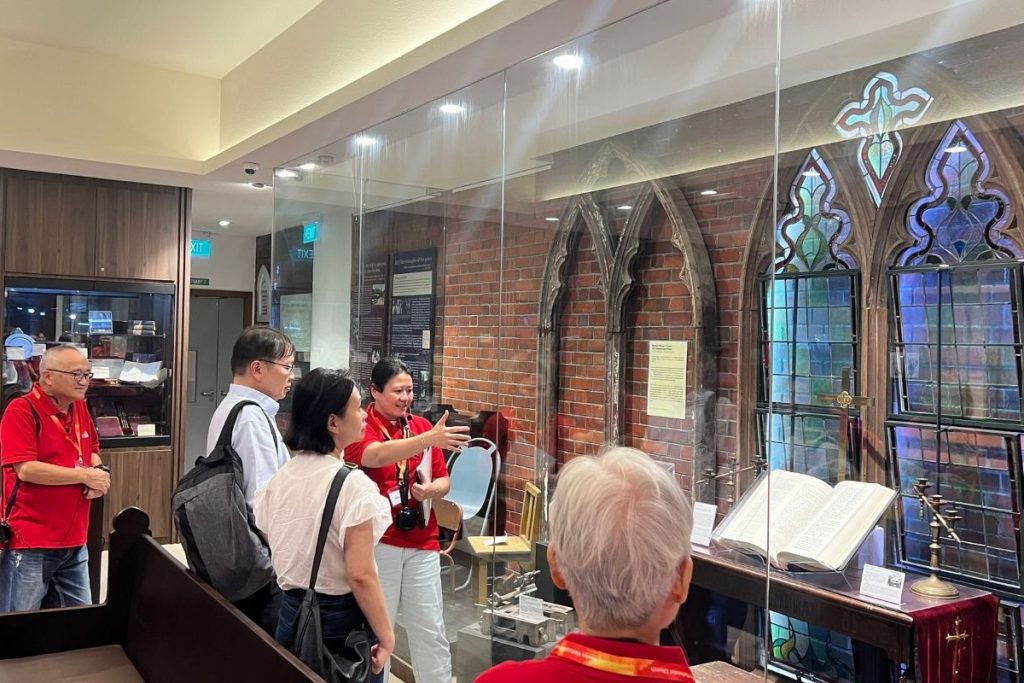
At the start of the docent training, the trainer emphasised that the ministry is run entirely by volunteers, unlike regular tour guides who are engaged professionally. At Wesley Methodist Church, the Wesley Heritage Trail is part of the church’s Vision 2035 to become a more welcoming community and create meaningful opportunities for people to step into our church premises during the week. 2 Hosted by our docents, the Heritage Trail invites both Christians and non-Christians to encounter the story of God’s faithfulness in Wesley Methodist Church’s history, experience Christian hospitality and perhaps even discover something of God’s presence for themselves.
I was grateful that the tour moved at a comfortable pace because I had been feeling mentally and physically exhausted. As we walked, I felt a small kinship with Christians who struggle to keep going in their ministry with God. While it was only physical exhaustion I felt, I was reminded of Christians who carry deep griefs in their souls and need the support of others to keep going. Thankfully, I found myself strengthened by the enthusiasm and joy of the docents who walked with me. The docents spoke not only about the history of the sites but also about how they themselves had been moved by the stories of God’s work. They were not simply narrating the past. They were witnessing to the ways God continues to shape their own lives. Their personal reflections demonstrate that although they were leading people around on these heritage tours, these docents were also, in Geoffrey Tristram’s perspective, walking the essential “journey of the heart”. 3 Listening to them reminded me that we need one another as we keep walking, keep encouraging one another and press on toward Christian perfection, as Hebrews 10:24–25 invites us to do.
“Their personal reflections demonstrate that although they were leading people around on these heritage tours, these docents were also, in Geoffrey Tristram’s perspective, walking the essential “journey of the heart”.”
HOPING: CONTINUE TO ANTICIPATE GOD’S REDEEMING WORK
As I stood on a university field that had once been a prison, the docent shared about a former inmate who was rehabilitated and eventually became a significant contributor to society. His story reminded me that even when a person has been written off as impossible or condemned, God is still able to do His surprising work. It made me wonder how I might better notice God’s redemptive activity, especially in the lives of those whom society has already dismissed, and how I might support that work with greater faithfulness.
Reflecting on Cardinal Newman’s words, “to live is to change and to be perfect is to have changed often”, I found myself concluding that the Christian who continues to take even the smallest step of sanctification is, in that very movement, most alive in Christ. 4
As we continue our respective journeys in this year of Sabbath Rest, I am asking God to form in us eyes that notice, a pace that loves, companions who strengthen and a heart that continues to anticipate His redeeming work.
1 Philip Sheldrake, Living Between Worlds: Place and Journey in Celtic Spirituality (London: Darton, Longman & Todd, 1995), 64–66.
2 The link for the Wesley Heritage Trail is wesley.sg/heritage
3 Geoffrey Tristram, “Pilgrimage: A Journey Within,” Society of St. John the Evangelist, November 16, 2018, https://www.ssje.org/2018/11/16/pilgrimage/.
4 Ibid.
(Photos courtesy of Pixabay.com)
Read also: God’s Gift of Enough