READ | SERMON NOTES
The Road to Emmaus – A Shattered Hope
“But we had hoped that he was the one who was going to redeem Israel.” (Luke 24:21a)
The two disciples on the road to Emmaus were walking away from Jerusalem, defeated. Like many Jews, they believed that the Messiah would come to restore Israel by overthrowing the Roman Empire and establishing a visible kingdom. Jesus fitted that hope – until He was crucified.
It was on this road of disappointment that Jesus drew close and walked with them. Their conversation exposed their core issue:
He said to them, “How foolish you are, and how slow to believe all that the Prophets have spoken! Did not the Messiah have to suffer these things and then enter his glory?” (Luke 24:25-26)
To believe ALL that the Prophets have spoken means:
- Not trimming uncomfortable truths
- Not emphasising only preferred parts
- Not reshaping God’s message to fit our expectations
We must not read Scripture through our own lenses of expectations and assumptions.
The importance of taking all of God’s Word as it is, is repeated in Luke 24:27. “And beginning with Moses and all the Prophets”, Jesus explained to the two disciples what was said in Scripture concerning himself.
Theological Preparation & Prophetic Anticipation of the Cross
“Moses” refers to the first five books of the Bible – Genesis, Exodus, Leviticus, Numbers and Deuteronomy. These books are a theological preparation and a prophetic anticipation of the cross.
Example 1
In Numbers 21:8–9, God instructs Moses to lift a bronze serpent so that those who look upon it may live. Jesus later refers directly to this event in John 3:14–15.
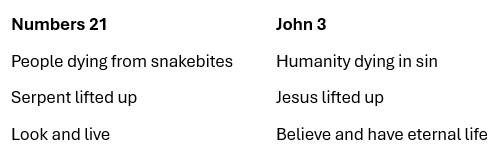
Both events are public and elevated. The bronze serpent is a visible reminder that sin brings judgement. The cross is a public declaration that sin is judged in Christ. God does not hide judgement; He reveals it to display grace and salvation.
Example 2
In Numbers 19:1-3, God instructs Moses and Aaron:
• Bring a red heifer without defect or blemish that has never been under a yoke
• The heifer is to be taken outside the camp and slaughtered in the presence of Eleazar the priest
This ritual foreshadows Christ’s crucifixion outside the city walls of Jerusalem at Golgotha.
“The high priest carries the blood of animals into the Most Holy Place as a sin offering, but the bodies are burned outside the camp. And so Jesus also suffered outside the city gate to make the people holy through his own blood.” (Hebrews 13:11-12)
Competing Voices
The core assumption of the two disciples was completely misdirected.
They were focused on Rome vs Israel but God was focused on sin vs a Holy God.
Their own voice of expectation: a political redeemer judging Rome
God’s voice in Scripture: The Messiah must suffer before entering His glory.
Many voices will speak in our journey of faith. But only one voice will lead us all the way home.
Known through the Word
Jesus is known through Scripture, not through our assumptions or expectations.
When Moses was on Mount Sinai receiving God’s Word, Aaron, pressured by the Israelites, built a golden calf. We should not create our own “golden calves” to understand God. God is known through His Word.
It was intentional that Jesus did not allow the two disciples to recognise Him before He opened the Scriptures to them (Luke 24:31). They were first brought into alignment to the complete truth of God and their hearts burned (Luke 24:32).
Discipleship Takeaway: Discipleship is the daily practice of letting God’s Word speak with greater authority than every competing voice.
We just need to open Scripture and be assured of the presence of God. We will feel our hearts burning as the beauty of His grace, His assurance and His love are revealed to us.
Heart of Discipleship: To know Jesus more clearly today than we did yesterday.
(Sermon notes by Stella Chiam)
PONDER | REFLECTION QUESTIONS
- As you reflect on Luke 24:13-35, what do you notice or find most meaningful?
- When you read Scripture, what are you hoping to notice or discover?
- The two disciples were “slow of heart to believe all that the prophets have spoken.” What does it mean to be “slow to believe” today? Are there parts of the Bible you tend to avoid or overlook, and how might that limit your understanding of Jesus’ full identity, mission, and work?
- How can we train ourselves to recognise Christ more clearly when we read the Old Testament?
- What is the significance of Luke 24:33 where the two disciples returned to Jerusalem?
- What is one key discipleship takeaway from the sermon?
- In what ways can you ensure that your understanding of Jesus is formed by God’s Word rather than your own ideas or preferences?